UPI MDR Above ₹2,000: What the New Payment Charges Mean for Merchants and Consumers
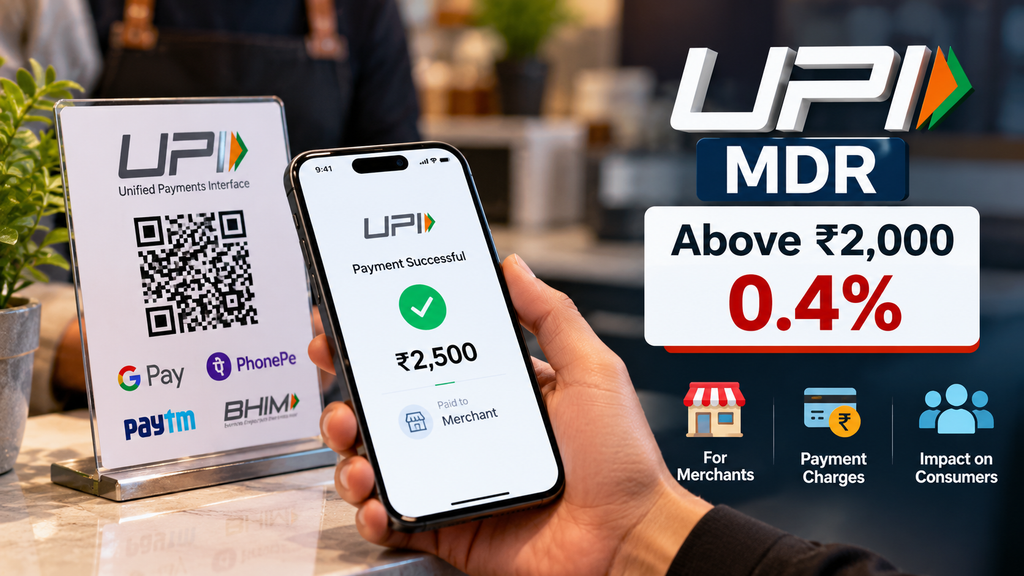
UPI Payments Enter a New Phase
India’s UPI ecosystem is preparing for a major change as a revised Merchant Discount Rate (MDR) framework is scheduled to take effect from October 15.
Under the new framework, eligible person-to-merchant UPI transactions above ₹2,000 will attract an MDR of 0.4%, according to recent reports. The change affects the economics of merchant payments while customers are not directly charged a UPI transaction fee.
The development is significant for India’s fintech sector because UPI has become one of the country’s most widely used digital payment systems.
What Is MDR?
Merchant Discount Rate is a fee associated with processing certain digital payments.
Under the revised framework, the applicable rate for eligible UPI merchant transactions above ₹2,000 is 0.4%. The framework is designed around merchant-side payment economics rather than introducing a direct fee for consumers.
The actual cost impact can vary depending on the type of transaction, merchant category and applicable caps or exemptions.
Will Customers Pay the 0.4% Fee?
Not directly as a UPI transaction charge.
The reported framework places the MDR within the merchant payment ecosystem. However, there is discussion about whether some businesses could indirectly reflect higher payment-processing costs in their pricing.
That means customers should distinguish between an official UPI transaction charge and any additional amount a merchant may separately include in a bill.
What Does It Mean for Merchants?
For businesses accepting UPI payments, payment-processing costs could become a more important consideration.
Merchants may need to review:
- Payment processing costs
- Pricing and margins
- Payment-provider agreements
- Transaction values
- Customer payment preferences
- Settlement processes
The impact will not necessarily be the same for every merchant because the framework contains different conditions and limits.
Why Is This Important for FinTech?
The change could influence how payment companies, banks and merchants structure digital-payment services.
UPI has traditionally been associated with low-friction transactions. A revised merchant pricing structure could encourage fintech companies to focus more heavily on:
- Payment infrastructure
- Merchant services
- Transaction efficiency
- Loyalty and rewards
- Payment analytics
- Business payment solutions
India’s fintech ecosystem is already expanding beyond basic payment processing into broader financial infrastructure and digital services.
UPI Still Remains a Major Digital Payment System
The MDR change does not alter the basic functionality of UPI.
Users can continue to make UPI payments through supported banking and payment applications. The main change concerns the economics of eligible merchant transactions.
Reuters reported that UPI accounts for around 84% of India’s digital payment volumes, highlighting the scale of the network.
What Should Consumers Watch?
Consumers should mainly look for transparency at checkout.
If a merchant adds any separate charge, customers should check:
- Whether the charge is clearly disclosed.
- Whether it is part of the advertised price.
- Whether the payment amount shown before confirmation matches the final bill.
- Whether another payment method has different pricing.
The introduction of MDR does not automatically mean every UPI payment will become more expensive for consumers.
What Comes Next?
The October 15 implementation will provide more clarity on how merchants and payment providers respond to the revised framework.
For India’s fintech industry, the development also highlights a broader question: how can a massive digital-payment infrastructure remain affordable for users while creating sustainable economics for the businesses operating it?
That balance will be important as digital payments continue to expand.